October 14
Restaurant Design · Seating Strategy
Seating Layouts for Small Restaurants: How to Maximize Every Seat Under 50 Guests
Small dining rooms have no margin for layout errors. The wrong table mix, a misplaced service aisle, or furniture spec'd to the wrong dimensions can cost you 10–20% of your potential cover count before you seat a single guest.
15
sq ft per person — the IBC occupant load factor for table seating (the code ceiling, not the comfort target)
IBC Table 1004.5 / NFPA 101 Table 7.3.1.2
40–60%
of visits at most casual restaurants are parties of one or two — the data that determines your ideal table mix
Cornell Center for Hospitality Research
5.1%
revenue increase achieved by redesigning table mix alone, with no additional seats added
Cornell CHR / Kimes & Thompson, published Cornell Hospitality Quarterly
Your Code Ceiling: Calculate Maximum Occupancy Before You Plan a Single Table
The first number every small-venue operator needs isn't a cover count — it's the occupant load ceiling set by code. Plan above it and you have a fire code violation. Plan without it and you'll make furniture and layout decisions you may need to undo after your first inspection.
The International Building Code (IBC Table 1004.5) and NFPA 101 Life Safety Code (Table 7.3.1.2) set the occupant load factors used by most jurisdictions in the U.S. For restaurant dining rooms, the relevant factors are:
| Use type | Occupant load factor | Area basis | Restaurant application |
|---|---|---|---|
| Table and chair seating | 15 sq ft per person | Net floor area | Standard dining room with tables and chairs or booths |
| Chair-only / standing | 7 sq ft per person | Net floor area | Bar areas with stools only, no table surface; cocktail standing areas |
| Waiting / queuing areas | 5 sq ft per person | Net floor area | Lobby, host stand waiting area, takeout queuing space |
The calculation is straightforward: divide the net floor area of each zone by the applicable factor. A 600-square-foot dining room with table seating has a code ceiling of 40 occupants (600 ÷ 15). Calculate each zone separately if your floor includes a bar area, then add the totals for your total occupant load.
Important
Net floor area excludes the kitchen, restrooms, storage, and service areas — only the space where guests actually sit is counted. Confirm your local Authority Having Jurisdiction (AHJ) adopts the IBC or NFPA 101, as local amendments can modify these factors. The posted maximum occupancy on your certificate of occupancy is the number that governs.
The occupant load ceiling is not your seating target — it's the upper bound for egress and life safety planning. Your practical seated capacity will always be lower once you account for ADA clearances, service aisles, and furniture footprint. A dining room with a code ceiling of 40 typically seats 28–34 comfortably with proper spacing, depending on table and chair configuration.
15
square feet per person is the IBC occupant load factor for table seating — calculated on net dining room area, not total building square footage. A 750 sq ft dining room has a code ceiling of 50 occupants; your real seated capacity, after aisles and ADA clearances, typically lands 15–25% below that number.
IBC Table 1004.5 / NFPA 101 Table 7.3.1.2 (2024 editions)
One practical implication: if you're in a space that was previously used as retail or office, its posted occupancy may be based on a different load factor entirely. Verify that the certificate of occupancy reflects restaurant/assembly use before designing your floor plan around it. Reclassification sometimes requires a permit — find out before you commit to furniture.
For a deeper look at occupancy compliance and posting requirements, see our guide on maximum occupancy safety guidelines for restaurants.
ADA Requirements Every Small-Venue Layout Must Meet
ADA compliance in a small dining room isn't just a legal obligation — it directly shapes where tables can go, how aisles must be routed, and which furniture you can spec. Getting this wrong means either retrofitting your layout after the fact or managing a complaint that becomes a lawsuit.
The 2010 ADA Standards for Accessible Design (the current governing standard) set these requirements for restaurant dining areas:
- Table height: Dining surfaces must be between 28 and 34 inches from finished floor to the top of the surface (Section 902.3). Most commercial dining tables fall within this range, but verify specs before ordering, particularly for specialty or imported pieces.
- Knee clearance: Accessible tables must provide a minimum 27 inches of vertical clearance, 30 inches of width, and 19 inches of depth under the table (Section 306.3.4). Center-post pedestal bases are the most common source of non-compliance — confirm that the base clears the 19-inch depth requirement.
- Clear floor space per accessible seat: A 30-by-48-inch clear floor area must connect to each accessible seating position. This space allows a wheelchair user to approach and pull up to the table and must align with an accessible route.
- Minimum accessible seating: At least 5% of dining surfaces must be accessible (minimum one table, per Section 226.1). Accessible seating must be dispersed throughout the dining room — it cannot be grouped in a single area or designated as an "accessible section."
- Accessible routes: A continuous 36-inch minimum clear width must run through the dining area connecting the accessible entrance to accessible seating and restrooms. Service aisles can double as accessible routes if they maintain this clear width.
ADA planning order of operations
- Identify your accessible route first — from entrance to accessible seats to restrooms — and protect it before placing any furniture. Everything else is arranged around it.
- Confirm your table base spec before ordering. A center-column pedestal base with a wide spread foot will often fail the 19-inch knee depth requirement. Four-post bases and T-bases with 30 inches of clearance between legs are the most reliable options.
- Plan for at least one accessible 2-top and one accessible 4-top if your layout allows. Dispersal across your seating zones is a compliance requirement, not a suggestion.
- If your dining room has booths along the perimeter, ensure accessible alternatives are available in the same area — not only in a different zone of the restaurant.
In a dining room under 50 seats, ADA-compliant placement typically consumes 2–4 tables worth of positioning decisions. Work these requirements into your floor plan from the start rather than trying to retrofit compliance after furniture is in place.
Aisle and Table Spacing: The Numbers That Determine Your Real Cover Count
Floor plans lose covers in two places: oversized aisles that don't need to be oversized, and undersized aisles that create service bottlenecks. In a dining room under 50 seats, every misallocated foot of aisle costs you a cover.
Service aisle hierarchy
Not all aisles require the same width. Assign widths based on traffic type, and you'll recover floor space without sacrificing service flow:
| Aisle type | Minimum width | Recommended | Notes |
|---|---|---|---|
| Accessible route (ADA) | 36" | 44" | Must run continuously from accessible entrance through dining area to accessible seating and restrooms; doubles as primary service aisle in most small venues |
| Primary service aisle | 36" | 44" | The path staff travel most frequently carrying trays, plates, or equipment; 44" allows two people to pass without turning sideways |
| Secondary service aisle | 30" | 36" | Paths between table rows where servers reach in to serve but don't walk through regularly; 30" is functional minimum |
| Guest circulation | 24" | 30" | Space between table edges (not including pushed-in chairs) for guests to pass to their seats; 24" is minimum, 30" is more comfortable at casual pace |
Chair overhang: the number operators consistently miss
Table-edge-to-table-edge clearance is only half the calculation. A dining chair pushed in to the table typically has 4–6 inches of rear leg overhang behind the table edge. A pulled-out chair extends 18–20 inches. When planning table placement, add 18 inches of chair depth to each occupied side of a table before measuring clearance to the next table or wall.
In practice: two 30×48" tables placed 30 inches apart edge-to-edge look fine on a floor plan. With chairs on both facing sides, the actual guest clearance is 30" minus roughly 18" (pulled-out chair depth on side A) minus another 18" (chair depth on side B) — a net clearance of approximately negative 6 inches. That's not a passable aisle. It's a collision point.
"Table spacing on a floor plan and table spacing with chairs and guests are two completely different numbers. Plan for chairs pulled out, not pushed in."
Operational standard — commercial restaurant layout planningCenter-to-center spacing reference by table format
| Table format | Table size | Min. center-to-center | Comfortable center-to-center |
|---|---|---|---|
| 2-top square | 24" × 24" | 48" | 54" |
| 2-top rectangle | 24" × 30" | 48" | 56" |
| 4-top square | 36" × 36" | 60" | 66" |
| 4-top rectangle | 30" × 48" | 60" | 68" |
| Bar stool at counter | — | 24" per stool | 26–28" per stool |
Table Mix Strategy: What the Research Shows for Under-50 Venues
Most operators intuitively default to 4-tops — they seat the most guests, they look substantial, and they feel like the "standard" restaurant table. For a dining room under 50 seats, this is usually the wrong call.
Cornell Center for Hospitality Research studies on table mix and RevPASH (Revenue Per Available Seat Hour) consistently show that at most casual restaurants, parties of one or two account for 40–60% of all visits. An all-4-top floor running 40% 2-person parties means 40% of your seats are persistently empty during those visits — capacity you're paying rent on and heating, but not converting to revenue.
5.1%
revenue increase was achieved by one restaurant that redesigned its table mix alone, with no additional seats added and no price changes. Seat occupancy during peak periods rose from 50% to 59%, and average dining duration dropped from 53 to 51 minutes — both a direct result of matching table format to actual party size.
Cornell CHR / Kimes & Thompson, "Restaurant Revenue Management at Chevys: Determining the Best Table Mix," Cornell Hospitality Quarterly
For a venue under 50 seats, the table mix implications are specific:
1
Make 2-tops your workhorse, not your afterthought
If your party size data shows 40–60% of covers are parties of one or two, your 2-top count should reflect that. A reasonable starting point for a casual 40-seat dining room is 8–10 two-tops, representing 40–50% of table count. Adjust from there once you have three to six months of your own party size data from POS.
2
Spec 2-tops that join cleanly into 4-tops
Two 24×30" tables pushed together create a 48×30" surface — serviceable for a party of four. Confirm that your table model has flush edges (not beveled or lipped) and that the bases allow two tables to sit directly adjacent without a visible gap. This combinability preserves flexibility without permanently committing square footage to 4-top format.
3
Limit dedicated large-format tables in rooms under 50 seats
A fixed 6-top or 8-top in a 40-seat dining room that regularly hosts parties of 2–4 is a cover-count liability. If large parties are a meaningful share of your business, use joinable 4-tops rather than a permanent large-format table. Reserve permanent large-format seating for venues where the concept or occasion type — private dining, group-focused format — justifies the dedicated square footage.
Key Takeaway
Run your own party size data before finalizing any table mix. If your POS tracks covers per check, pull it for the last 90 days and find the actual distribution. A floor plan built around your real guest patterns will outperform any generic formula — including this one.
Booths, Tables, and Counter Seating: How Each Performs in a Small Room
The decision between booths, tables, and counter seating isn't primarily aesthetic. Each format has a distinct footprint, dwell time effect, and revenue-per-square-foot profile — and in a room under 50 seats, those differences compound.
Booth seating
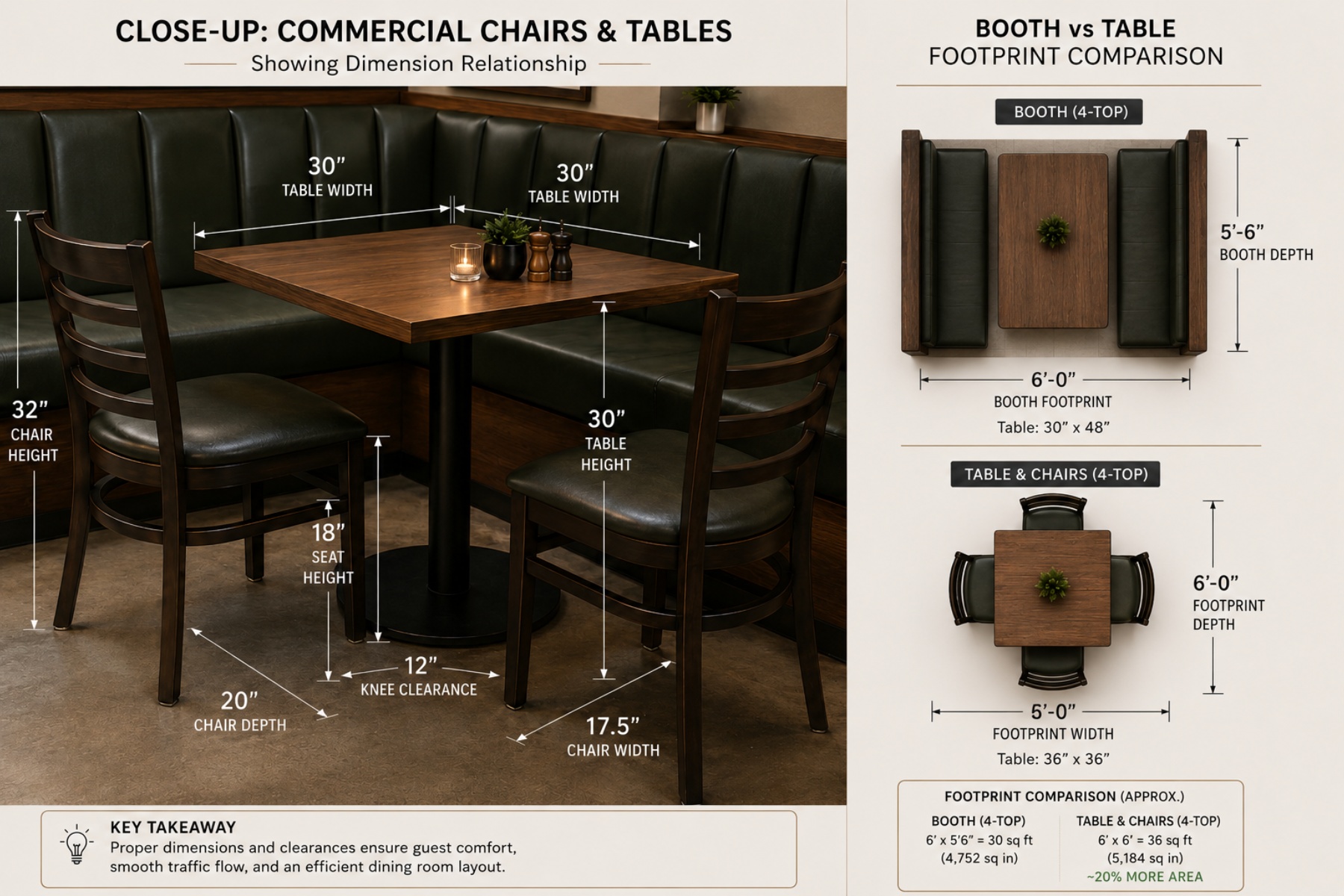
A 4-person booth occupies roughly 3,000 square inches of floor space. A 4-top table with four chairs — with chairs pulled in — requires more than 5,000 square inches for equivalent seating. The space efficiency of booth seating is real and significant in tight dining rooms.
The tradeoff is dwell time. Fixed booth seating is physically comfortable in a way that encourages guests to stay longer. That's an asset in concepts where check size benefits from longer visits — wine bars, neighborhood bistros, date-night concepts. It works against throughput in concepts where table turns per night drive profitability.
Booths are also structurally fixed. Once installed along a wall run, they don't reconfigure for different party sizes without the guests noticing. A 4-person booth hosting a party of 2 isn't wasting floor space the way an oversized table wastes floor space — but it is running half its seat count empty, which is the same efficiency problem in a different form.
For small venues, the strongest use of booth seating is along perimeter walls, where the fixed placement doesn't interfere with the flexibility of the main dining room. A perimeter of booths combined with a flexible table-and-chair core gives you the space efficiency of booths where walls allow it and the reconfigurability of tables where you need it most.
See our full breakdown of booth dimensions, sizes, and spacing standards in the restaurant booth size and spacing guide.
Tables and chairs
The flexibility advantage of table seating is the ability to right-size for the party in front of you. Two 2-tops can become a 4-top; two 4-tops can become an 8-top. That's not possible with fixed booth seating.
Chair selection matters more than most operators account for. A compact side chair with a seat width of 17–18 inches typically projects 20–22 inches from a table edge when a guest is seated. A wider armchair at 22–24 inches wide projects 24–26 inches. In a 40-seat room where you're fitting chairs along both sides of multiple table rows, that 4-inch difference per chair side translates directly to whether you can fit an additional table row or not.
Commercial restaurant chairs with a stacking profile are worth specifying in small venues — not only for storage but for same-day reconfiguration when event bookings or large parties arrive. A chair you can stack and move in 10 seconds gives you a dining room that can shift layouts mid-service when needed.
Counter and bar seating
Counter seating is the highest-density format available. At 8–12 square feet per person versus 15–18 for table seating, a well-placed counter run can seat 6–8 guests in the space a pair of 4-tops would occupy. The catch is dwell time: counter seating turns faster than table seating, which makes it the right format for breakfast, lunch, solo diners, and concepts where throughput is the primary revenue driver.
For a small venue that has a wall, window run, or service bar with appropriate height, a 6–10 seat counter section is one of the highest-return additions available. Commercial bar stools spec'd to match your counter height (seat height = counter height minus 10–12 inches) at 26–28 inches center-to-center is the standard placement formula.
Seating type
Space per cover
Best fit in a small venue
Booth (perimeter)
~12–14 sq ft per cover
Wall runs where fixed placement doesn't sacrifice main floor flexibility; date-night and neighborhood concepts where longer dwell time supports check size
Table + chairs (2-top)
15–18 sq ft per cover
Core of the dining room; combinable into 4-tops; right-sized for the 40–60% of visits that are parties of one or two
Table + chairs (4-top)
18–22 sq ft per cover
Dedicated 4-tops justified when party size data confirms consistent 3–4 person visits; fewer fixed 4-tops than operators default to
Counter / bar stools
8–12 sq ft per cover
Highest-density format; best for solo diners, lunch, quick-service concepts, and venues with a wall or window run that can anchor a counter
For more on how booth, banquette, and bench seating compare in commercial environments, see restaurant booths and seating.
Zone Strategy for Under-50 Dining Rooms
A dining room that functions as one undifferentiated zone leaves money on the floor in two ways: it forces the same spacing and furniture choices on areas that have different traffic, service, and guest experience needs; and it makes the room feel either cramped everywhere or sparse everywhere, depending on how you optimized it.
Even in a 600–800 square foot dining room, three distinct zones are workable and dramatically improve both the guest experience and operational efficiency:
1
Perimeter zone — booths or banquettes along walls
Wall-adjacent seating has natural perceived privacy that walk-in guests actively prefer. Position your booth or banquette runs here. These seats book first, sustain longer visits, and make efficient use of the wall square footage. Keep your accessible seating requirement in mind: at least some accessible seating must be included in or adjacent to this zone, not only in the center of the room.
2
Core zone — flexible table-and-chair configuration
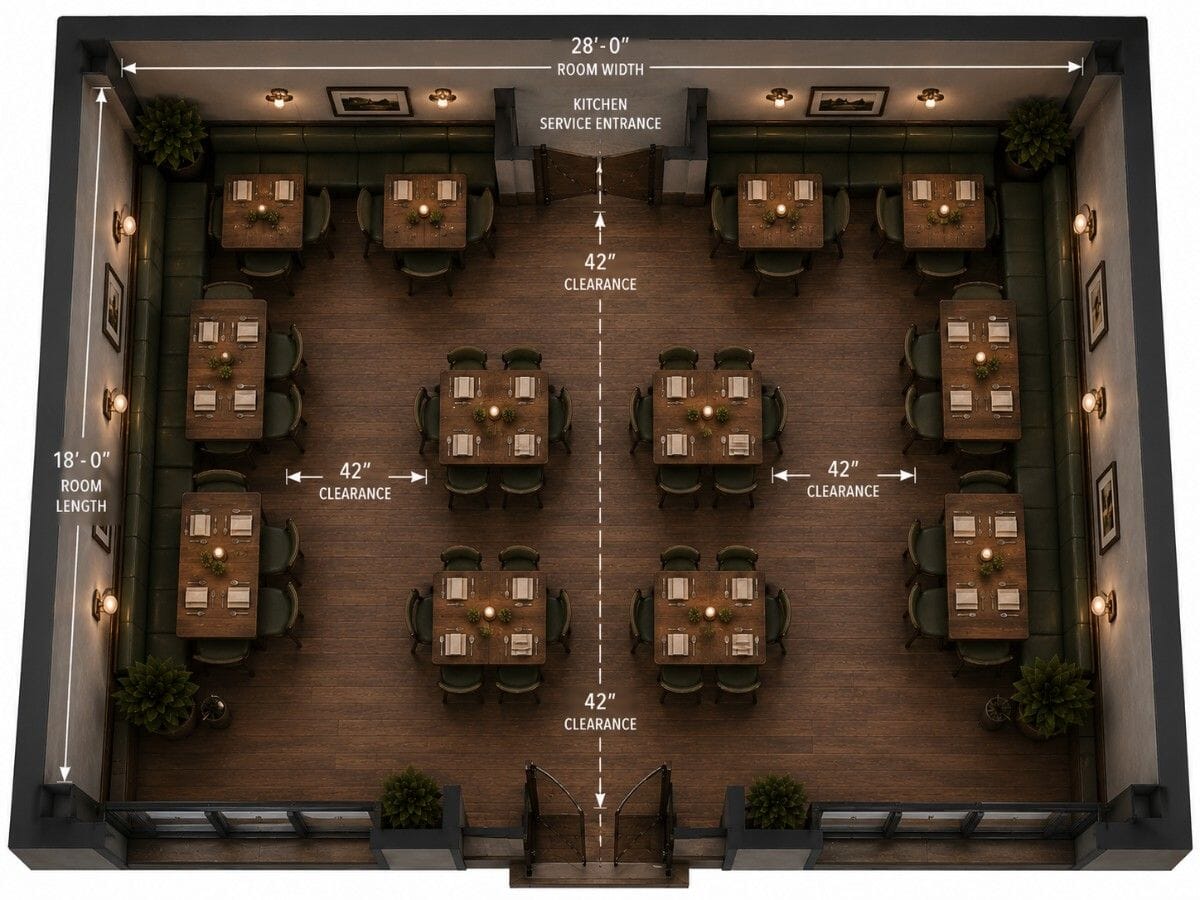
The main floor should be your most flexible zone. Spec joinable 2-tops and 4-tops here. This is where your service aisle hierarchy matters most: a clear primary aisle through the core is the operational spine of the room. Tables in this zone should be reconfigurable — chairs that stack, tables that combine — so the floor can shift for large parties or private event bookings without a furniture overhaul.
3
High-density zone — counter or bar seating where geometry allows
If your floor plan has a window run, a service bar with a ledge, or a wall that faces a street-side view, a 6–10 seat counter section adds covers at the highest density available without consuming primary floor space. This zone turns faster than the rest of the room, which makes it the right placement for solo diners, lunch-rush covers, and walk-in guests who aren't waiting for a table.
Zone planning checklist
- Mark your primary service aisle first — from kitchen exit to the farthest corner of the dining room — before placing any furniture. This aisle is fixed; everything else works around it.
- Confirm that your ADA accessible route (36" minimum) overlaps with or parallels your primary service aisle. In a small venue, maintaining two separate pathways wastes more floor space than it's worth.
- Position your host stand so the sight line from the entry reaches the full dining room. In a venue under 50 seats, a host who can see every table from the door is a seating efficiency advantage — no walking the room to find available covers.
- If you have a window wall, use it for seating rather than decoration. Window seats are high-demand in dining rooms and don't require additional square footage — they use exterior wall space that otherwise goes unmonetized.
Three Layout Archetypes for Small Venues
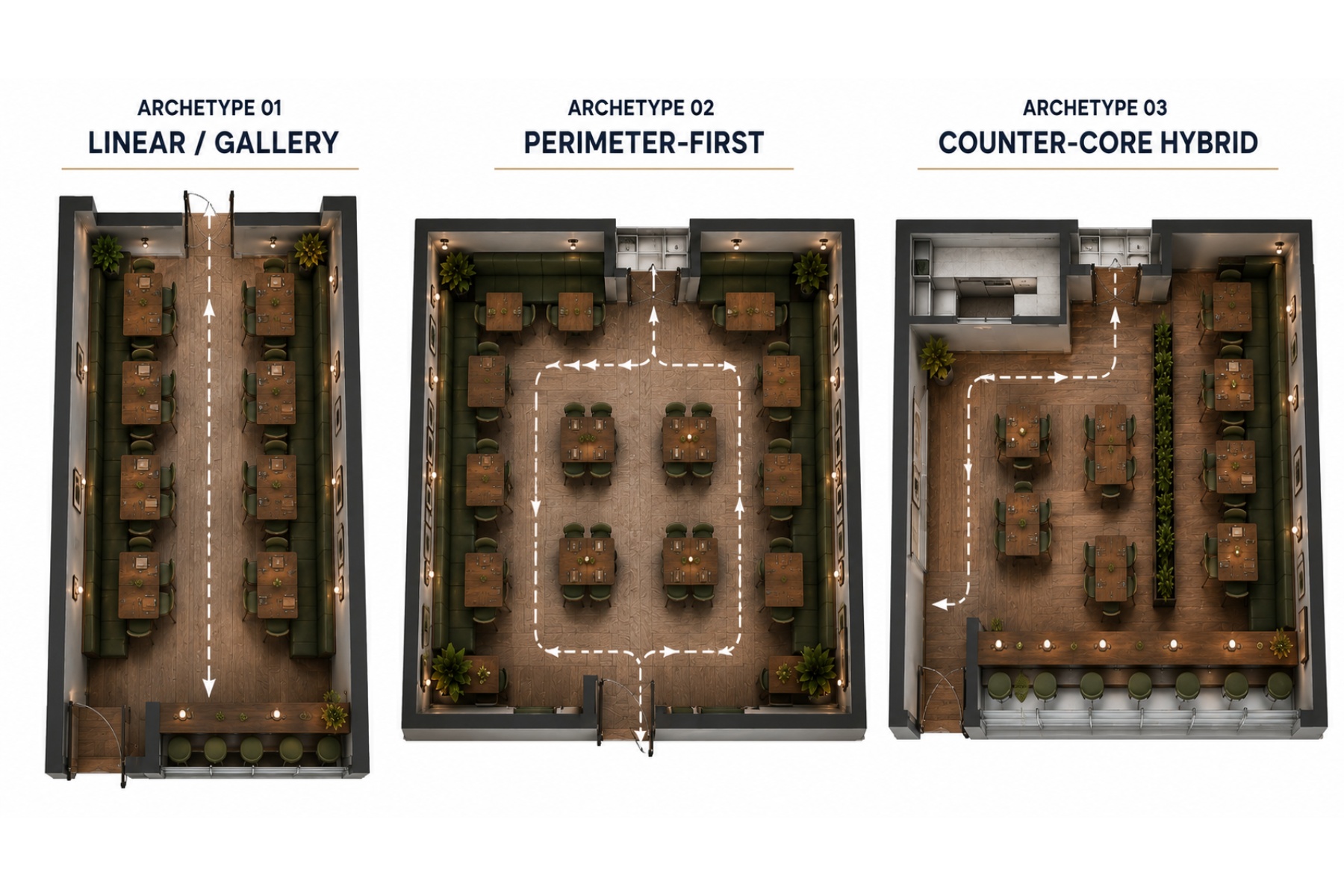
Most dining rooms under 50 seats resolve into one of three basic layout configurations. The right archetype depends on your room shape, service flow, and concept type — not a one-size-fits-all prescription.
Archetype 01
Linear / Gallery
Narrow or rectangular rooms
Tables in two rows running the length of the room, with the service aisle down the center. Booth or banquette seating along one or both long walls. Efficient for throughput; less suited to large group accommodation. Common in converted rowhouse or retail spaces. Works well with counter seating along a window-facing wall at the front.
Archetype 02
Perimeter-First
Square or near-square rooms
Booths or banquettes along all available wall runs; flexible table-and-chair configuration in the center. The perimeter carries the intimate seating; the center carries the flexible capacity. Standard configuration for neighborhood bistros and wine bars. Requires careful attention to the center's service aisle so the perimeter seating doesn't become isolated from the kitchen path.
Archetype 03
Counter-Core Hybrid
Concepts with a street or window face
Counter seating along the street-facing window; table seating in the interior. The counter captures walk-in and solo traffic at high density; the table section handles groups. Works exceptionally well for cafés, brunch concepts, and lunch-forward operations where a significant portion of guests are solo or parties of two. Requires a counter at the right height with appropriate commercial stools.
For a more detailed look at how floor plan decisions connect to the rest of your restaurant build-out, see our guide on how successful restaurants start with a great floor plan.
The Furniture Dimensions That Determine Your Cover Count
A floor plan is an abstraction. Cover count is determined by the actual physical dimensions of the furniture you order. The gap between the two is where operators consistently lose 2–4 seats they thought they had.
Table sizing: how much surface area per person
Linear table edge per diner is the starting spec for any table purchase. The range runs from 18 inches per person in a cafeteria or high-density casual format to 26–28 inches in fine dining. For most full-service restaurants, 24 inches of table edge per person is the standard — comfortable but not wasteful:
| Concept type | Table edge per person | Typical 2-top size | Typical 4-top size |
|---|---|---|---|
| Café / casual / counter service | 18–20" | 24" × 24" | 30" × 36" or 24" × 48" |
| Casual full-service | 22–24" | 24" × 30" | 30" × 48" or 36" × 36" |
| Upscale casual / neighborhood bistro | 24–26" | 30" × 30" | 36" × 48" or 36" × 36" |
| Fine dining | 26–28" | 30" × 36" | 36" × 48" or 42" × 42" |
A 30×30" 2-top spec'd for a casual full-service concept where 24" per person is the standard is 6 inches wider than necessary on both axes. Across 10 two-tops, that's 5 feet of combined footprint you don't need — potentially enough for one additional 2-top and the aisle to service it.
Chair dimensions and the footprint multiplier
Chair dimensions have a direct multiplier effect on table spacing and cover count. The critical measurements are seat width (determines how many chairs fit in a row) and seat depth plus back height (determines how far the chair projects from the table edge when in use).
- Seat width: Compact commercial side chairs run 17–18" wide. Standard side chairs run 19–21". Armchairs run 22–24" wide. In a row of 8 chairs along a wall or booth face, the difference between 18" and 22" wide chairs is 32 inches of linear space — which in a small room is the difference between fitting 8 or 7 chairs comfortably.
- Chair depth in use: A pushed-in chair projects 16–18" from the table edge. A pulled-out chair projects 18–22". Plan floor spacing based on pulled-out dimensions — the code doesn't care about the floor plan, it cares about what actually happens when guests are seated.
- Stackability: A chair that stacks allows you to reset your room layout in under 10 minutes when an event booking or large party calls for it. For venues under 50 seats that take private events or have a flexible format, stackability is a functional spec requirement, not a convenience preference. See our commercial chair catalog for stackable commercial options.
Bar stool spec for counter seating
The seat height formula for bar stools is fixed: subtract 10–12 inches from counter height to get your target seat height range. A 42-inch bar counter needs a 28–30" seat height stool. A 36-inch counter-height surface needs a 24–26" seat height stool. Order outside this range and the seating is uncomfortable regardless of style — a mistake that's expensive to fix once stools are installed. For a complete bar height specification guide, see the restaurant bar stools guide.
Before You Order
Draw your floor plan to scale — actual scale, not approximate — before speccing any furniture. Mark the service aisle, the ADA accessible route, and the chair footprint at each table in the pulled-out position. Seats that fit on a sketch but not on a scaled drawing are seats you'll be apologizing for on opening night.
Ready to spec commercial seating for your dining room?
Superior Seating carries commercial-grade chairs, tables, booths, and bar stools built for the dimensions and durability demands of restaurant use.
Frequently Asked Questions
How many square feet per person does a restaurant need?
The International Building Code (IBC Table 1004.5) sets the occupant load factor for table seating at 15 square feet per person of net floor area. Bar and counter seating zones using only stools — no tables — calculate at 7 square feet per person. These are code minimums for egress and life safety purposes, not comfort targets. For a comfortable dining experience, most operators plan 15–18 square feet per cover for table seating; tighter casual concepts run 12–15 square feet. Your practical seated capacity will typically run 15–25% below the code ceiling once ADA clearances and service aisles are accounted for.
What is the minimum aisle width between restaurant tables?
ADA Standards for Accessible Design require a minimum 36-inch clear width for accessible routes through the dining area. Primary service aisles used by staff carrying trays or equipment should be 44 inches minimum. Secondary aisles between rows where staff reach in to serve, but don't walk through regularly, can be 30–36 inches. Guest circulation between table edges (not including pushed-out chairs) runs 24–30 inches as a practical standard. Always plan spacing with chairs pulled out, not pushed in — the gap that looks sufficient on a floor plan often collapses to an impassable bottleneck once guests are seated.
How many tables should a small restaurant have?
For venues under 50 seats, Cornell Center for Hospitality Research studies on table mix show that 2-tops and 4-tops should make up the majority of the floor. At most casual restaurants, parties of one or two account for 40–60% of visits, which means an all-4-top floor is running significant empty seats. A reasonable starting mix for a casual 40-seat room is 8–10 two-tops (some combinable into 4-tops), 4–6 dedicated 4-tops, and no permanent large-format tables unless your party size data specifically justifies them. Adjust once you have 90 days of your own party size data from POS.
Are booths or tables better for a small restaurant?
A 4-person booth occupies roughly 3,000 square inches of floor space; a 4-top table plus four chairs requires more than 5,000 square inches for equivalent seating. Booths win on space efficiency and tend to increase dwell time — which helps check size in concepts where longer visits generate more revenue. Tables and chairs win on flexibility: they can be reconfigured for different party sizes. For most small venues, the optimal solution is a perimeter of booths along available wall runs combined with a flexible table-and-chair core in the main dining area.
What ADA seating requirements apply to small restaurants?
Under the 2010 ADA Standards for Accessible Design, at least 5% of dining surfaces must be accessible (minimum one table). Accessible tables must be between 28 and 34 inches high (Section 902.3), with knee clearance of at least 27 inches high, 30 inches wide, and 19 inches deep (Section 306.3.4). A 30-by-48-inch clear floor space must be provided at each accessible seat, and accessible seating must be dispersed throughout the dining room — not clustered together. Accessible routes through the dining area must maintain a minimum 36-inch clear width. These requirements apply to all restaurants regardless of size.
How do I calculate maximum occupancy for my restaurant?
Divide the net floor area of each zone by the applicable occupant load factor from IBC Table 1004.5: 15 sq ft per person for table seating, 7 sq ft for bar or standing areas. Calculate each zone separately, then add the totals. The result is your code ceiling — your actual comfortable seated capacity will typically be lower after ADA clearances and service aisles are accounted for. Always confirm with your local Authority Having Jurisdiction, as local code amendments may apply. See our full guide on maximum occupancy for restaurants for more detail on posting requirements and compliance.