October 14
Banquet & Event Seating
10 Types of Banquet & Event Seating Arrangements
Floor plan diagrams, square footage standards, and spacing specs for every setup — from banquet rounds to theater, conference to cabaret.
10
seating styles covered — with diagrams and spacing specs
6–15
sq ft per person — range across all setup types
NACE industry standards
10yr
frame warranty on commercial aluminum banquet chairs
Superior Seating guarantee
In this guide
The wrong seating arrangement doesn't just make an event feel awkward — it reduces capacity, slows service, and creates flow problems you cannot fix once chairs are in the room. The right arrangement, matched to the event format and room dimensions, determines how many covers you can seat, how efficiently staff can move, and whether guests stay engaged or start checking their phones.
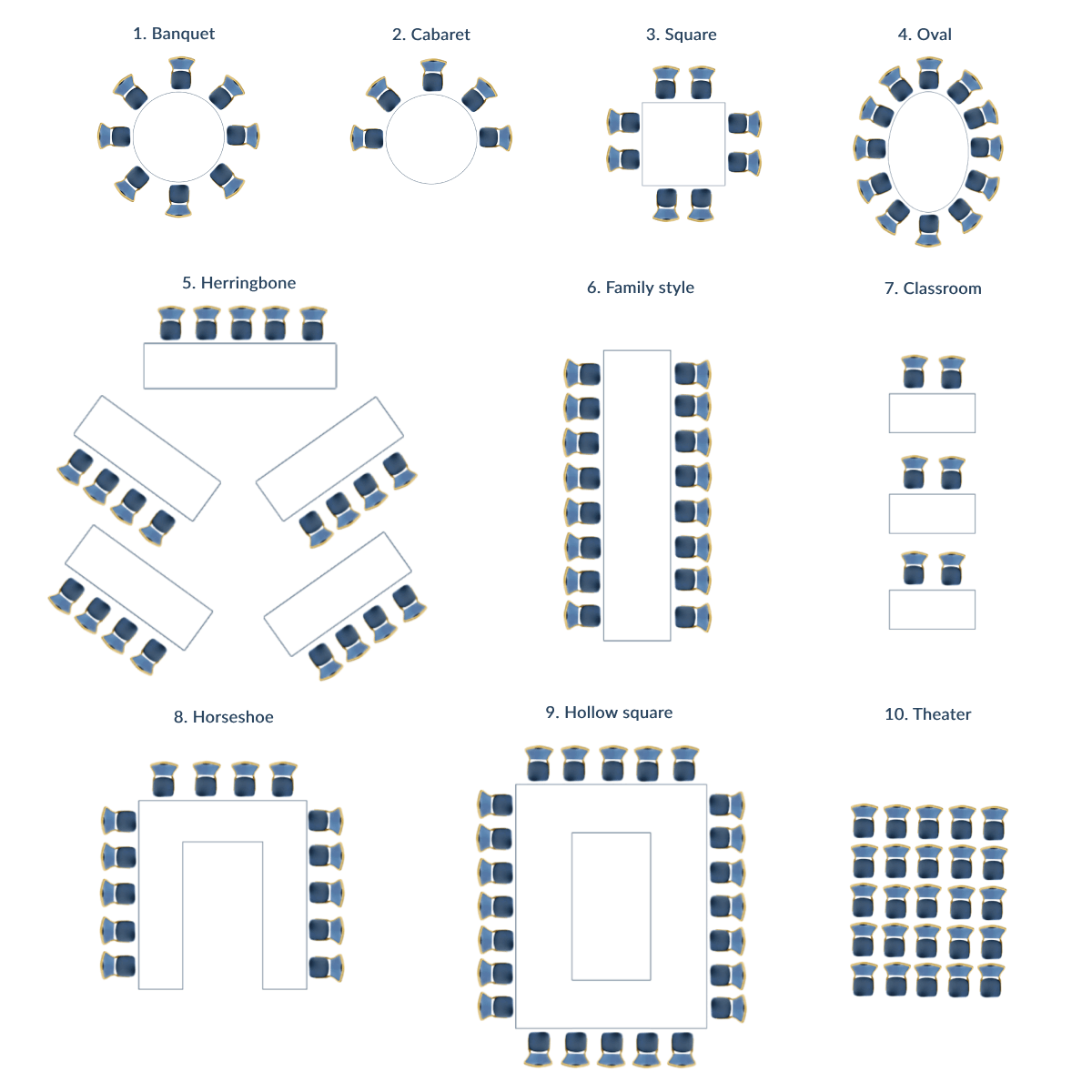
Seating arrangements for events fall into ten recognized configurations. Each one has a specific space footprint, a specific use case, and a specific chair requirement. This guide covers all ten — with top-down diagrams, square footage standards sourced from industry guidelines, and commercial chair specifications for operators buying at scale.
Before you start
The National Association of Catering and Events (NACE) recommends 10 to 12 square feet per person as the baseline for round-table banquet seating. Always add 20 to 30 percent on top for service zones, circulation paths, and staging. Hotels frequently advertise maximum capacity based on the densest possible layout — verify with your own floor plan before ordering chairs.
Quick Reference: All 10 Seating Styles at a Glance
Use this table to narrow your setup before reading the full section for your chosen style.
| Seating style | Sq ft per person | Best event type | Interaction level | Capacity efficiency |
|---|---|---|---|---|
| Banquet (rounds) | 10–12 sq ft | Weddings, galas, corporate dinners | Social | High |
| Cabaret | 12–14 sq ft | Awards shows, dinner theatre, hybrid conferences | Social + Presentation | Moderate |
| Square | 10 sq ft | Small meetings, intimate dinners, workshops | Collaborative | High |
| Oval | 14 sq ft | Formal dinners, receptions, fundraisers | Social | Low–Moderate |
| Herringbone | 12 sq ft | Conferences, training, lectures | Presentation | Moderate |
| Family style | 10 sq ft | Communal dinners, reunions, casual weddings | Social | High |
| Classroom | 10 sq ft | Training, seminars, workshops | Presentation | Moderate–High |
| Horseshoe / U-shape | 14 sq ft | Board meetings, interactive workshops | Collaborative | Low |
| Hollow square | 14–38 sq ft | Committee meetings, group discussions | Collaborative | Low |
| Theater | 6–8 sq ft | Presentations, keynotes, screenings | Presentation | Very High |
87%
of meetings were conducted in-person in 2023. Getting the physical seating arrangement right directly impacts whether attendees can see, participate, and engage — or sit frustrated in the wrong chair in the wrong row.
Cvent, 2024
Style 01
10–12 sq ft/person
Round tables
Most common
Banquet Seating
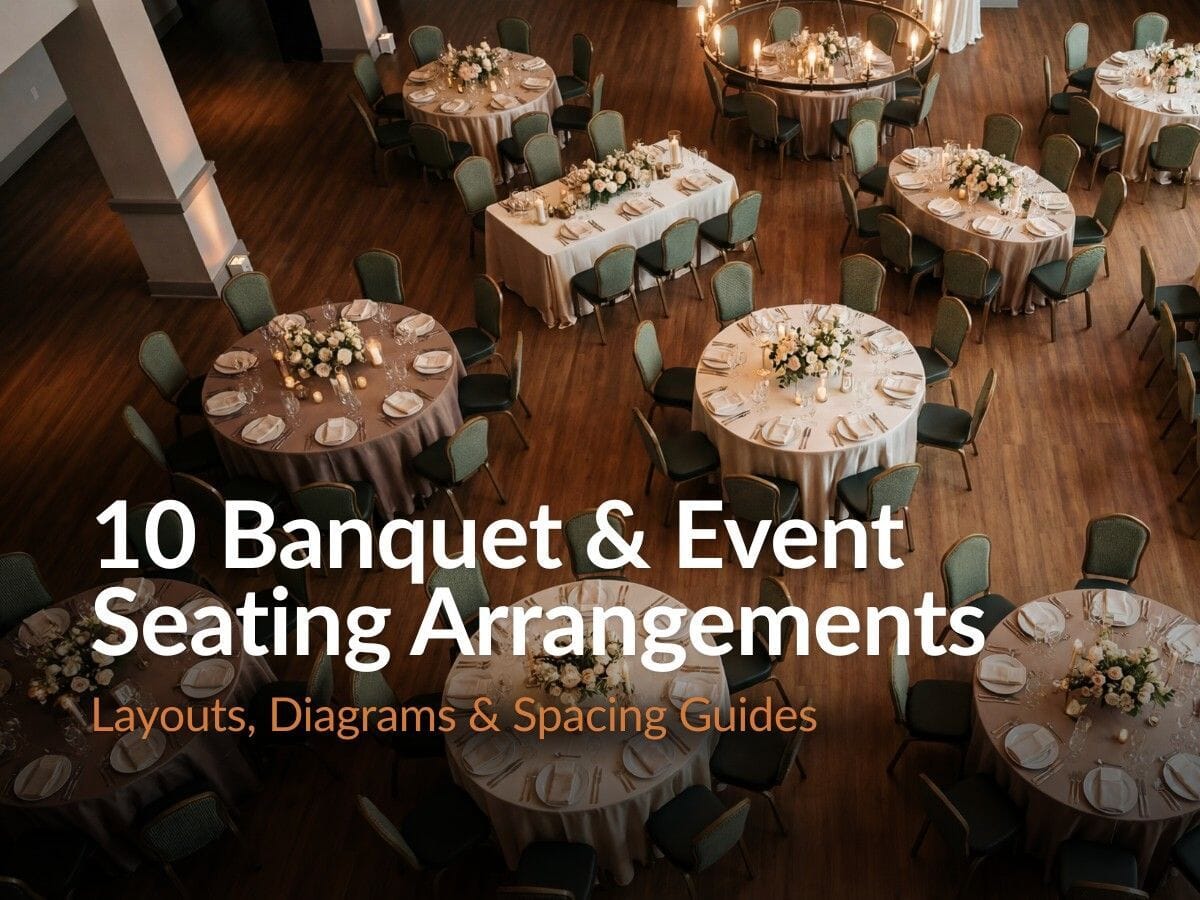
Banquet seating is the industry default for good reason. Round tables seat 8 to 10 covers each, encourage conversation in every direction, and allow servers to reach every guest from a single table position. For venue operators, this translates directly into cover density, service efficiency, and the kind of ambient energy that keeps guests at the table longer.
The standard configuration uses 60-inch round tables with chairs surrounding the full perimeter. Maintain a minimum of 54 inches between table edges — enough for servers with trays and for guests to push chairs back without blocking the aisle. Main traffic aisles require 60 inches minimum. Allow 18 inches from table edge to the back of the chair so guests can sit comfortably without the person behind them feeling crowded.
Banquet rounds work in ballrooms, large banquet halls, hotel event spaces, and outdoor tented venues. They are the right choice for weddings, gala dinners, corporate award ceremonies, and any event where the dining experience is the event — not a side activity.
Top-down diagram
10–12
sq ft per person
54"
min between table edges
60"
main traffic aisle width
Chair recommendation: Stackable commercial aluminum banquet chairs — look for models that stack 8 to 10 high to minimize storage footprint. The Eliseo, Orion, and Voss from our banquet collection all stack 10 high with flex-back construction for long-event comfort. View the full banquet & event furniture collection.
Style 02
12–14 sq ft/person
Round tables, open side
Cabaret Seating
Cabaret seating is banquet seating with one side of each table left open toward a stage or presentation area. Guests face both their tablemates and the focal point — which is why it works for events that need social dining AND a clear sightline to a performance or speaker. The tradeoff is reduced capacity: a table that seats 8 in full banquet configuration seats 5 to 6 in cabaret.
The open end of each table should face the stage within a 45-degree angle of center. Tables angled beyond 45 degrees create uncomfortable sightlines for guests on the outer seats. Maintain at least 60 inches between table edges — the open side creates more chair movement than standard banquet, and servers need the clearance. Traffic aisles run to 54 inches minimum.
Cabaret is the correct setup for awards ceremonies, dinner theatre, hybrid conference-dining events, and any format where guests need to eat and watch simultaneously. Hotels running multi-purpose event spaces use cabaret specifically because it converts to full banquet by adding chairs to the open side.
Top-down diagram
12–14
sq ft per person
60"
min between table edges
54"
main traffic aisle width
Chair recommendation: No-armrest stacking chairs maximize seating capacity on the three occupied sides. Flex-back construction is worth specifying for dinner-show events that run 2 to 3 hours. The Artisan and Theron are well-suited — both stack high and offer flex-back. See the full banquet seating collection.
Style 03
10 sq ft/person
Square tables
Square Seating
Square seating places guests around individual square or small rectangular tables, typically 4 per table, in a grid arrangement. It is the most flexible configuration for small to medium-sized event spaces — tables are easy to combine into larger configurations or separate into breakout groups mid-event. Every guest has a direct line of sight to every other guest at the same table.
Standard spacing requires 18 inches from table edge to chair back. Maintain 42 inches minimum between table backs for back-to-back seating, with 6 additional inches accounted for chair pull-out. Main traffic aisles should reach 60 inches. At 10 square feet per person, square seating achieves comparable density to banquet rounds while giving the room a more structured, contemporary feel.
Square seating suits small meetings, intimate dining events, breakout workshop rooms, and venues that need to reconfigure quickly between different event formats. Its simplicity makes it the fastest setup to build and strike.
Top-down diagram
10
sq ft per person
42"
min between chair backs
60"
main traffic aisle width
Chair recommendation: Slim-profile stacking chairs without armrests keep table access clean on all four sides. The Artisan and Harlan from our aluminum frame collection are well-suited to square configurations. Browse the full banquet event collection.
Style 04
14 sq ft/person
Oval tables
Formal events
Oval Seating
Oval seating uses long oval tables with chairs placed around the full perimeter. It carries a formal, traditional register that works in upscale banquet facilities, hotel ballrooms, and event spaces where the aesthetic of the setup is part of the event itself. The elongated shape accommodates larger groups at a single table than square seating allows, while maintaining the face-to-face dynamic of round table seating.
Oval tables require more floor space than standard round tables — allocate 14 square feet per person and maintain at least 54 inches between table edges. Main aisles require 60 inches. The chairs on the long sides of the table will have a slightly angled view of the person directly across, which is acceptable for 10 to 14 covers but becomes a sightline problem at larger configurations.
Oval seating is appropriate for formal dinners, high-end receptions, fundraising galas, and corporate events where the setup needs to signal status. It is less suitable for events requiring rapid reconfiguration, since oval tables are heavier and harder to reposition than standard rounds.
Top-down diagram
14
sq ft per person
54"
min between table edges
60"
main traffic aisle width
Chair recommendation: Formal events call for chairs with a more refined profile. The Elio round-back armchair and Thalia from our hospitality collection pair well with oval arrangements at upscale events. View the hospitality furniture collection.
Style 05
12 sq ft/person
Angled rectangular tables
Herringbone Seating
Herringbone seating angles rows of rectangular tables in a V-formation pointing toward a front stage or screen. Every seat in the room has a clear sightline to the focal point — which is the problem classroom-style seating creates for the outer seats in a wide room. Diagonal placement also reduces the effective depth of each row, meaning herringbone fits more rows into the same length of room than parallel classroom rows.
The angle of each table typically sits between 30 and 45 degrees off parallel. Allocate 12 square feet per person and allow 24 inches between corners of diagonal tables for guest access without a dedicated aisle. Main traffic aisles require 54 inches. Allow 18 inches from table edge to chair back.
Herringbone is most effective in conference centers, training facilities, and hotel ballrooms running full-day conference programs. The configuration signals that attention is expected — it works against the dynamic at networking or dining events where multi-directional conversation is the goal.
Top-down diagram
12
sq ft per person
24"
between diagonal table corners
54"
main traffic aisle width
Chair recommendation: Flex-back chairs are worth the specification for all-day conference programs. The Voss and Lucca — both stacking 10 high with flex-back — handle herringbone configurations efficiently. Browse our banquet chair collection.
Style 06
10 sq ft/person
Long rectangular tables
Family Style Seating
Family style seating runs long rectangular tables in parallel rows, with guests seated on both long sides and occasionally the ends. Shared platters down the center of each table define the service format — the arrangement encourages conversation the length of the table rather than across it. The setup is inherently informal and communal, which is exactly the right register for farm-to-table events, family reunions, casual wedding receptions, and harvest-style dinners.
Allocate 10 square feet per person. Allow 18 inches from table edge to chair back. Maintain 42 inches minimum between table backs for back-to-back seating, accounting for 6 inches of chair pull-out. Traffic aisles should reach 54 inches. Long tables seat more guests per linear foot than rounds — which is why this setup is popular for high-capacity outdoor events where round tables would eat too much space.
Family style works best in casual dining spaces, outdoor venues, rustic event locations, and any setting where the intended atmosphere is relaxed and convivial. It is less suited to formal events or any configuration requiring clear sightlines to a stage.
Top-down diagram
10
sq ft per person
42"
min between chair backs
54"
main traffic aisle width
Chair recommendation: Lightweight stacking chairs without armrests keep the long-table feel open and make flip-and-stack end-of-event turnover fast. The Harlan and Alaric stack 10 high and suit the casual register of family style events. See the full banquet furniture collection.
Style 07
10 sq ft/person
Rows facing front
Conference + training use
Classroom-style Seating
Classroom seating arranges rectangular tables in rows facing a front focal point — a screen, whiteboard, or speaker position. Every attendee has a work surface for notes, a laptop, or materials. The format maximizes attention on the presenter and gives the room an orderly structure that attendees read immediately as "learning environment." This is the preferred setup for corporate training sessions, seminars, workshops, and educational conferences.
Maintain 60 inches between rows — the deepest spacing requirement of any presentation-oriented setup — to allow comfortable access to center seats and to let staff circulate between rows during breakout activities. Allow 18 inches from table edge to chair back. Allocate 10 square feet per person.
Conference style seating — where participants sit around a single large table in a boardroom configuration — is the smaller-group counterpart to classroom style. Conference arrangements work for groups of 6 to 20 where discussion and equal participation matter; classroom works when groups exceed that and one-way instruction or presentation is the primary format.
Top-down diagram
10
sq ft per person
60"
between rows
18"
table edge to chair back
Chair recommendation: Flex-back chairs with ganging mechanisms allow rows to be linked for aligned theater-to-classroom reconfiguration. The Eliseo and Artisan both stack 10 high and are available in steel or aluminum frames — steel is a cost-efficient option for high-volume training facility orders. View banquet and event seating.
Style 08
14 sq ft/person
U-shape tables
Horseshoe Seating
Horseshoe seating — also called U-shape — arranges tables in a three-sided U with an open end facing the presenter or facilitator. Every participant has an unobstructed view of the presenter and of every other participant. The open center also gives the facilitator room to move through the group, conduct hands-on exercises, or use a central presentation area without being separated from the audience by a table barrier. This is the correct setup for interactive workshops, board meetings, group training sessions, and any event where engagement between facilitator and participants is as important as engagement among participants.
Allocate 14 square feet per person. Maintain 42 inches between chair backs for back-to-back clearance. Confirm 18 inches from table edge to each chair back. Main aisles require 60 inches minimum. The open end of the U should face the presentation point and remain fully clear — do not allow chairs to close the open end, which turns horseshoe into a hollow square and eliminates the facilitator-access advantage.
Top-down diagram
14
sq ft per person
42"
between chair backs
60"
main aisle minimum
Chair recommendation: Comfortable flex-back chairs without armrests keep the open horseshoe perimeter uncluttered and allow free movement in and out of the configuration. The Asher and Arvid stack 10 high and are suited to long-session workshop environments. Browse our hospitality and meeting seating collection.
Style 09
14–38 sq ft/person
Four-sided table square
Hollow Square Seating
Hollow square seating closes the horseshoe into a full four-sided square — every participant faces the center, and every participant faces every other participant. This is the conference style arrangement for large groups: it works where a single conference table is too small but a presenter-focused layout would undermine the collaborative dynamic the group needs. It is commonly used for committee meetings, panel discussions, multi-stakeholder planning sessions, and academic group formats.
Allow 24 inches per chair along the table perimeter — tighter than the 18-inch banquet standard, reflecting that hollow square is typically a meeting format where attendees are working at the table surface rather than primarily dining. Provide ample space around the outer perimeter for entry and exit access. Use the open center for shared materials, a moderator position, or display. For groups over 30, the format becomes unwieldy because participants at the opposite side of the square are too far for effective conversation.
Top-down diagram
24"
per chair at table
30
max effective group size
14–38
sq ft per person (varies by table size)
Chair recommendation: Slim, armless stacking chairs with a straight back and professional appearance suit the meeting register of hollow square. The Artisan and Alaric both deliver the clean, professional look and stack 10 high. Browse the hospitality seating collection.
Style 10
6–8 sq ft/person
Chairs only, no tables
Highest capacity
Theater Seating
Theater seating achieves the highest attendee density of any configuration — 6 to 8 square feet per person versus 10 to 14 for table-based setups. Chairs are placed in rows facing a stage or screen, with no tables. This is the correct format for large presentations, keynote speeches, product launches, film screenings, performances, and any event where attendees are listening and watching rather than working or dining. For venue operators, it is the configuration that maximizes the revenue-per-square-foot of a large room for single-session events.
Maintain 36 inches between rows for legroom and access. Allow 24 inches per chair along each row — tighter than table-based configurations since there is no table footprint to accommodate. Arrange chairs in straight lines to optimize viewing angles, and plan dedicated aisle lanes 44 to 60 inches wide for emergency egress compliance. For ganged-row configurations, specify chairs with welded wire or retractable gangers to keep rows aligned throughout the event.
Top-down diagram
6–8
sq ft per person
36"
between rows
24"
per chair in row
Chair recommendation: Lightweight chairs that stack 10 high and can accept ganging mechanisms are essential for theater setups — setup time, storage density, and row alignment all depend on it. The Eliseo aluminum frame at 11 lb is the lightest in our collection and stacks 10 high. Steel frame options are available at a lower price point for high-quantity theater deployments. Add optional welded wire or retractable gangers for row alignment. View all banquet and event chairs.
Common Mistakes in Event Seating Setup
These errors are consistent across venue types and event sizes. Most cannot be corrected once the room is set and guests are arriving.
6 mistakes to plan past
- Using the venue's advertised capacity as a planning number. Hotels and event spaces publish maximum capacity based on the densest possible configuration. That number assumes minimal furniture, tight spacing, and no staging, service stations, or circulation allowance. Always build your own floor plan from real dimensions and subtract 20 to 30 percent for service zones before ordering chairs.
- Under-sizing aisle width. The 60-inch main aisle standard exists for two reasons: server access with trays and emergency egress clearance. Reducing aisles to 48 or 36 inches to gain an extra row creates service problems mid-event and may violate fire code in jurisdictions requiring 44-inch minimum egress paths.
- Choosing seating style after booking the venue. The format of your event should determine the room, not the other way around. If your conference program requires horseshoe seating for 40 people, you need a room that can support it at 14 square feet per person plus service clearance — before you sign a contract.
- Specifying residential chairs for commercial event use. Residential-grade chairs are not rated for the wear cycles of commercial event use. A chair used 200 times per year at a high-turnover venue will fail well before the 3-year mark without commercial-grade frame construction. Specify 12-gauge aluminum or 16-gauge steel minimum for any seating bought for event use.
- Ordering chairs that don't stack or gang. Storage footprint and setup time are operational costs. Chairs that stack only 4 or 5 high require significantly more storage space and slow room turnover between events. For any venue running multiple events per day, specify chairs that stack a minimum of 8 to 10 high. Ganging capability is a functional requirement for theater and classroom configurations where row alignment matters.
- Closing the open side in horseshoe and cabaret setups. The functional advantage of both configurations depends on keeping the open end clear. Adding chairs to fill the horseshoe opening converts it to a hollow square and removes facilitator access. Closing the open side of cabaret tables blocks the sightline that justifies the arrangement. Mark the open ends on your floor plan before the room is set.
Commercial chairs built for every setup
12-gauge aluminum frames, 10-year warranty, 14 frame finishes, and stacking heights up to 10 high. COM upholstery and ganging mechanisms available.
Frequently Asked Questions
What is banquet style seating?
Banquet style seating places guests at round or rectangular tables with chairs arranged on all sides, encouraging social interaction and dining. It is the standard setup for weddings, gala dinners, corporate events, and large social gatherings. The National Association of Catering and Events recommends 10 to 12 square feet per person for round-table banquet seating with plated service. Maintain a minimum of 54 inches between table edges and 60 inches for main traffic aisles.
What is conference style seating?
Conference style seating places all participants around one large rectangular or oval table, with everyone facing the center. It is the standard format for boardroom meetings, executive sessions, and discussions where direct face-to-face interaction among all participants is required. Conference style works best for groups of 6 to 20. For larger groups, horseshoe or hollow square arrangements deliver a similar collaborative dynamic at greater scale. Allocate 25 to 40 square feet per person depending on table size and room configuration.
What is cabaret style seating?
Cabaret style seating places guests at round tables with seating on three sides only, leaving one side open toward a stage or presentation area. It combines the social dining quality of banquet rounds with a clear, unobstructed sightline to a focal point. Cabaret is the standard setup for awards ceremonies, dinner theatre, corporate conferences with dining components, and any event where guests need to both eat and watch. It requires 12 to 14 square feet per person and at least 60 inches between table edges.
How much space per person do you need for banquet seating?
NACE recommends 10 to 12 square feet per person for round-table banquet seating with plated service. Weddings with dance floors require 12 to 15 square feet per person. Corporate banquet dinners typically work at 10 to 12 square feet. Theater-style seating without tables can go as low as 6 to 8 square feet per person. Always add 20 to 30 percent to your base seating calculation for service zones, circulation paths, staging, and bar or buffet areas.
What is the difference between banquet seating and classroom seating?
Banquet seating places guests around round or rectangular tables in a dining arrangement where conversation is multi-directional. Classroom seating arranges rectangular tables in rows all facing a front screen or presenter, with one to three participants per table section. Banquet is the right setup for dining events where social connection is the goal. Classroom is the right setup for training sessions, seminars, and workshops where learning is the primary activity. Both require approximately 10 square feet per person, but classroom requires 60 inches between rows while banquet requires 54 inches between table edges.
What chairs work best for banquet and event seating?
Commercial-grade aluminum banquet chairs are the standard for event and banquet venues. Key specifications: 12-gauge aluminum frame minimum, stackability of 8 to 10 high for efficient storage, flex-back construction for long-session comfort, Cal 117 fire safety rating, and 400-pound weight capacity minimum. Chairs that stack 10 high significantly reduce the storage footprint and speed room turnovers between events. Ganging mechanisms allow rows to be linked for theater and classroom configurations. For formal events, specify armchair versions for head-table positions. COM upholstery options allow chairs to be matched exactly to a venue's brand color palette.